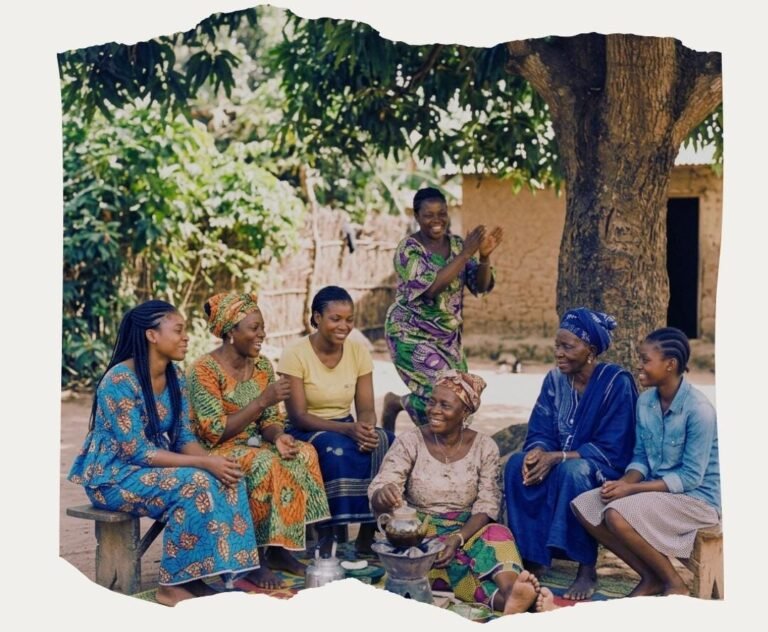

“A survivor’s memory of the “Bii-rayy” and the hidden trauma of Female Genital Mutilation.”
There it was: confusion. The environment itself felt chaotic – the scent of blood, dry and fresh, hanging in the air. The cries of young girls. Mothers and older women moving in and out, in and out.
Then came the noise.
A loud, unfamiliar sound echoed through the compound.
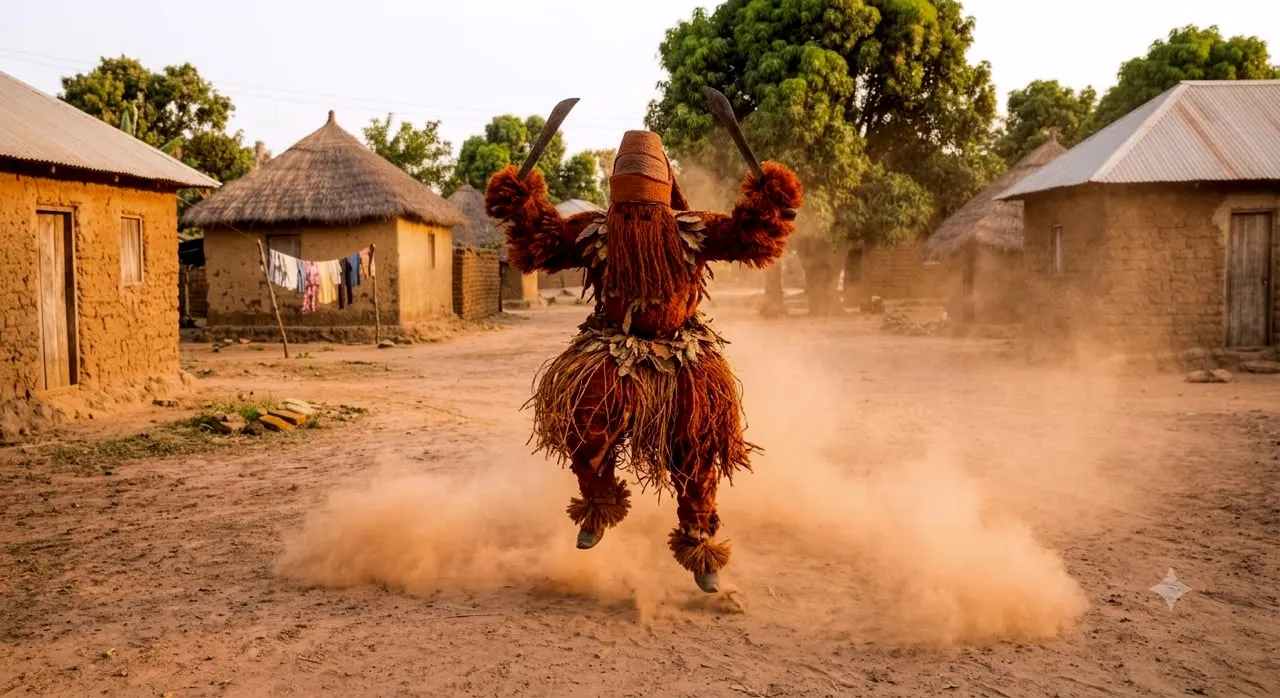
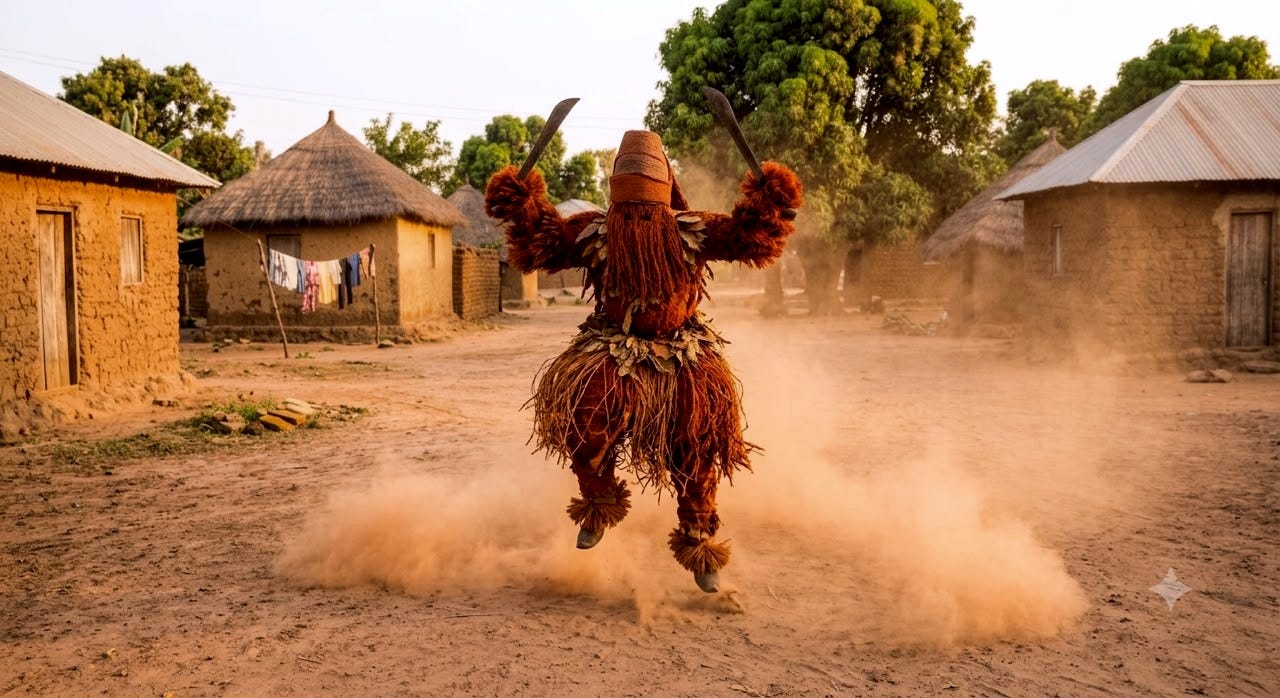
It was the masquerade.
Covered in red.
As though the colour itself carried a warning.
The fear intensified. The cries grew louder. Mothers looked anxious. Aunts whispered. Grandmothers watched silently.
And in the middle of it all were children whose fear had already become too much.
Questions filled their minds.
Who is this giant dressed in red?
Why is it carrying a rusty knife?
Why is it running around making sounds we have never heard before?
The questions were never asked out loud.
But the answers came anyway.
“It is the guiding spirit.”
“The protector of the compound.”
“The one that exposes evil.”
“The one that knows the intentions of everyone who enters.”
That was what we were told.
Locally, it was called the “Kankurang”.
But this was no ordinary “Kankurang”.
This was the mighty “Efangbondi” – the masquerade that, according to local belief, dressed itself.
As children, we were told it could appear in your house in the middle of the night. You dared not peep through the window because it could feel your gaze. People said the cutlass of the “Efangbondi” could spark fire. That it moved like a spirit – appearing one moment and disappearing the next.
Whether those stories were true did not matter.
We believed them.
And fear does not need proof to become real.
This compound held something the rest of the village didn’t.
It was the “Bii-rayy” It gathers hundreds of women and girls, lined up to be mutilated.
Right there, in the middle of the compound, stood a small, round hut. That’s where the screams were coming from. Girls, five years old and older – sometimes way younger – walked in. But here was the confusing part: anyone who walked in on two feet came out tip-toeing, or carried – by a mother, by a guardian. Some mothers were too frightened to even escort their own daughters.
But she was always there.
The old woman.
Bold. Respected. Feared.
She held the trembling hands of little girls who had no idea what waited for them inside. Girls terrified of the unknown – of something they could not see and no one would explain.
For many of the women, it was never described as violence.
It was pride.
It was identity.
It was belonging.
It was acceptance.
Imagine hundreds of women and girls placing their trust in the bloodstained hands of one elderly woman.
People believed she possessed spiritual powers. That she could distinguish good from evil. That she had been chosen for this work.
Whether those beliefs were true did not matter.
People believed them.
She walked with her shoulders high, carrying an authority that few questioned. Parents invoked her name to discipline young girls. Children feared disappointing her as much as they feared the cutting itself.
The cutting happened on one particular day.
What followed were days of initiation and rites of passage.
To many girls, it felt less like a celebration and more like punishment – a forced journey into womanhood long before they understood what womanhood meant.
Children stopped behaving like children.
There were unwritten rules.
Never stand up from a shared bowl before everyone else.
Stretch your legs.
Bend your head.
Always obey.
Always remain quiet.
Small mistakes attracted harsh punishment.
Girls learned very quickly that childhood had conditions.
There were also days when the “Bii-rayy” welcomed a man.
He never entered the sacred spaces.
That was forbidden.
Instead, he arrived carrying herbs.
Bundles of leaves and roots believed to heal the little girls who had fallen ill after the cutting.
When a girl developed a fever or became too weak to stand, people rarely spoke of infection or injury.
They believed something evil had entered her.
That the illness was spiritual, not physical.
The herbs were prepared carefully, and the women watched with hope, believing they would drive away whatever unseen force had made the child sick.
And then, without warning, the masquerade would return.
Whenever its presence was announced, the entire “Bii-rayy” fell silent. Laughter vanished. Conversations stopped. Every child became perfectly still.
The compound transformed into something that felt like a graveyard.
Quiet.
Cold.
And somehow, even the wind still seemed to carry the smell of dried blood and fear.
But not every day inside the “Bii-rayy” was filled with screams.
Some days felt almost ordinary.
I remember sitting beside my grandmother, helping her make beautiful beads with careful little hands. Around us, the older women prepared for the final celebration.
There was excitement.
Girls who had survived the initiation would soon be dressed in colourful beads, wrapped in beautiful cloth, and adorned with sweets and biscuits.
The compound slowly transformed.
The cries became songs.
The songs became louder with each passing day.
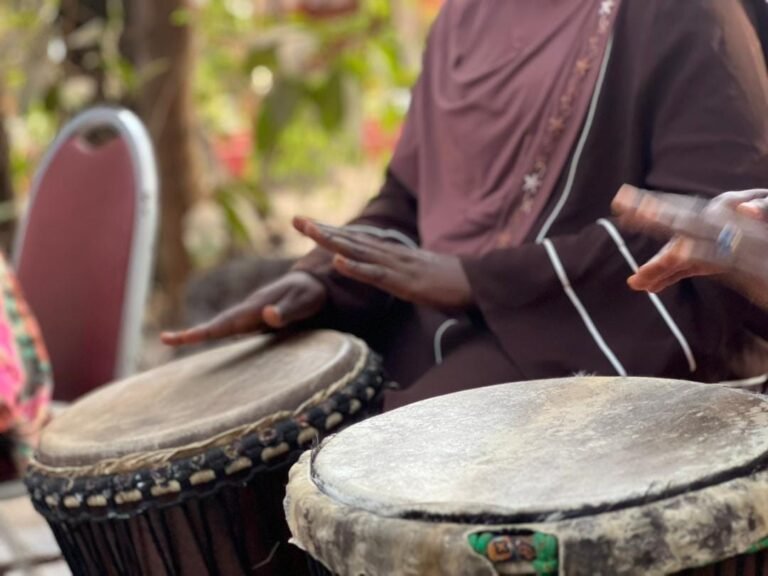
Drums echoed through the air.
Women danced.
Laughter returned.
There was pride in their eyes.
Joy.
Relief.
Celebration.
Many of them genuinely believed they had guided their daughters into respectable womanhood. They celebrated not because they wished harm upon girls, but because they had inherited a tradition they believed was honourable, necessary, and loving.
And that is perhaps one of the greatest tragedies of all.
That women who had themselves been harmed could celebrate the same harm being passed on to another generation – believing they were protecting their daughters, when in reality, they were perpetuating a cycle of violence they had been taught to call culture
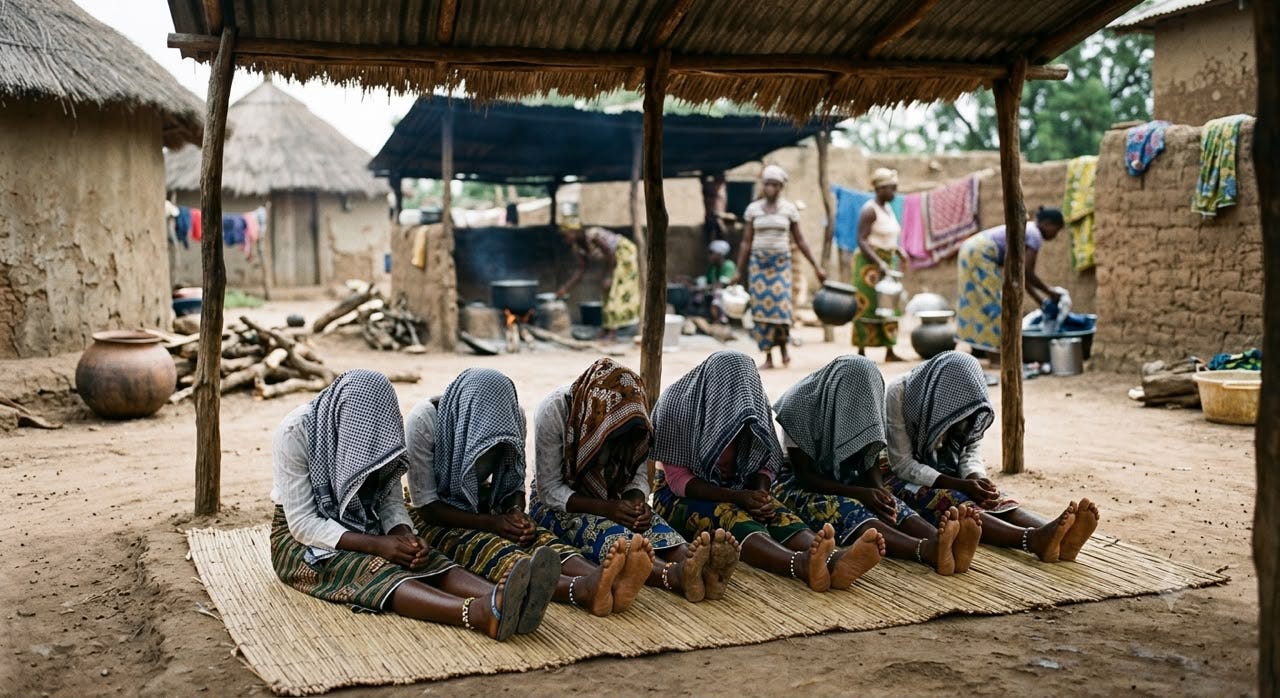
Every girl in that compound carried a different story.
Some left physically healed.
Others left frail.
Some carried scars that no one could see.
But they all had one thing in common.
Every girl entered that hut whole.
Every girl left with a part of her body permanently removed.
A piece of her body cut away, thrown to the vultures.
These are the stories of the women and girls who have undergone FGM.
But the story doesn’t end there. The trauma is only just beginning. Inside that “Bii-rayy”, it might look like every girl chose to be there.
That is not the reality.
That compound is filled with children who are far too young to understand what is happening around them – children who cannot comprehend the lifelong consequences of what is about to happen, and who have neither the power nor the freedom to say no.
And then there are those who arrive later.
Women and girls who were never physically forced into the hut, but who were pushed there by something just as powerful.
Years of rejection.
Years of humiliation.
Years of being told they were not enough.
In their marriages.
In their schools.
Within their own families.
On the streets where they played.
Often by other women and girls who had themselves been socialized to believe they were somehow better – more desirable, cleaner, purer, worthy of respect, worthy of marriage, worthy of belonging.
The insults echoed everywhere.
“Solima.”
“Solima.”
“Solima.”
To those who carried that label, every word cut deeper than the last.
For many of them, saying “yes” to FGM was never an expression of free choice.
It was the price of acceptance.
The price of dignity.
The price of belonging.
They wanted to be seen as clean.
As respectable.
As marriageable.
As “real” women.
They longed for an identity that society had convinced them could only come through mutilation.
When your humanity is measured by what has been taken from your body, consent becomes far more complicated than simply saying “yes.”
The trauma of FGM does not end when the wound heals.
It follows you.
Sometimes it returns in your dreams.
You catch the imaginary scent of dried blood.
You hear the cries of little girls who never stopped screaming.
You remember the silence that fell whenever the masquerade appeared.
Even years later, your body remembers what your mind tries to forget.
Some people think only the girl who was cut carries the trauma.
But that is not true.
Sometimes witnessing violence leaves wounds of its own.
Even if you were never taken into that hut, the “Bii-rayy” never truly leaves you.
Its sounds.
Its smells.
Its fear.
Its silence.
They become part of you.
I do not remember when I was cut.
Perhaps I was too young to understand what was happening.
Perhaps my mind buried those memories somewhere I cannot reach.
But I remember every single detail of the day my two younger sisters were taken.
I remember the screams.
I remember the blood.
I remember the fear.
I remember the masquerade.
I remember the old woman.
I remember waiting.
I was only ten years old.
If I can still remember those moments so vividly today, then perhaps people were right.
The “Bii-rayy” was never just a place.
It was an experience that marked every child who entered it.
Some on their bodies.
Others on their hearts.
And for many of us, those scars never truly disappear.
Annex: A Note on Local Terms
Bii-rayy – A traditional initiation ground where girls’ rites of passage, including cutting, take place.
Kankurang – A traditional masquerade figure believed to serve as a guiding and protective spirit within the compound.
Efangbondi – A particularly feared form of the Kankurang, said by local belief to dress itself and move with spiritual power.
Solima – A derogatory term used against girls and women who have not undergone FGM, implying they are unclean, undesirable, or unfit for marriage.