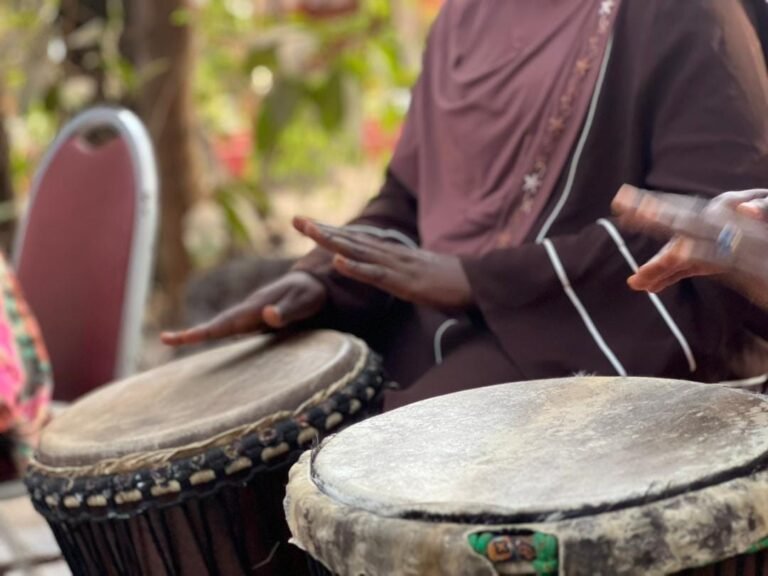
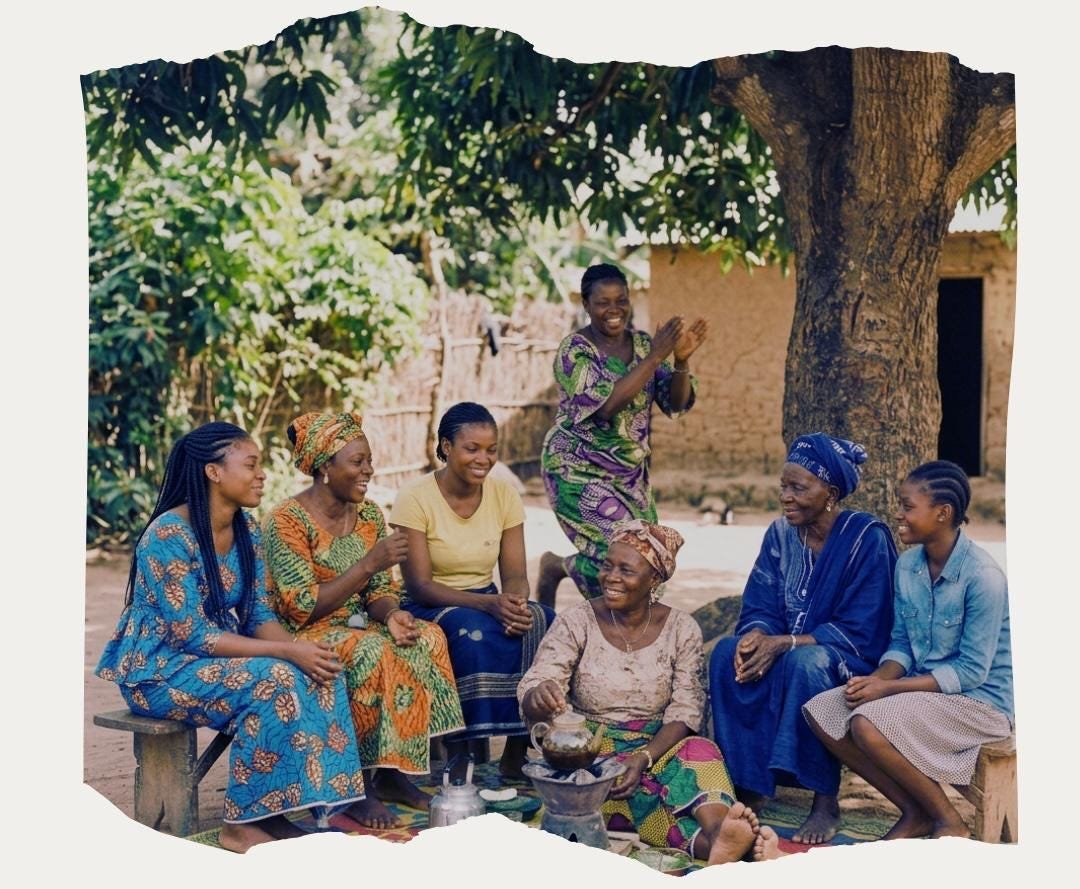

“What Kafos, Kompins, and Osusu circles can teach us about solidarity, joy, and collective power.”
They will tell you feminism is not ours.
They say it with confidence – in radio studios, in Friday sermons, in the comment sections of Facebook posts where women dare to speak about their own lives. They say the word is borrowed. That the ideas came on a plane from somewhere else, landed in the hands of educated women with foreign funding, and have been causing trouble ever since. They say our grandmothers did not need it. That our culture has always respected women. That this – whatever this is – is not who we are.
But here is what I keep thinking about.
I keep thinking about my grandmother’s “Kafo”. About the sound of women arriving – the greetings layered on top of each other, the laughter starting before anyone has even sat down. About the “ashoebi” fabric they chose together, the way they showed up to each other’s occasions looking like a garden in full colour. About the “Osusu” meetings where the “ataya” was always brewing, always filling the room with that warm, slightly smoky scent that means something good is about to happen.
I keep thinking: if this is not feminism, then someone needs to explain to me what feminism is.
Because those women – our grandmothers, our great-aunts, the older women in our compounds whose names we sometimes only know as “Mama” – they were already doing the work. Long before the word arrived. Long before anyone thought to write it down or put it in a funding proposal.
They were doing it in circles, in courtyards, over cups of tea, in matching fabric, with their whole hearts.
The “Kafo”: Where No Woman Was Left Behind
The “Kafo” – called the “Kompin” in Wolof, different words for the same beautiful thing – was not something women were invited into. It was something women built. For themselves. Out of the understanding that life is simply too heavy to carry alone.
And so they gathered. Women from the same compound, the same neighbourhood, the same stretch of road – coming together not because anyone told them to, but because they had looked at each other and made a quiet, unspoken agreement: I will show up for you, and you will show up for me.
When a woman in the “Kafo” gave birth, the others came. They did not wait to be called. They arrived with their hands already ready – cooking, fetching water, sweeping the compound, keeping the older children busy so the new mother could do something she was rarely given permission to do: rest. In a world that expected women to keep going no matter what, the Kafo created a pocket of grace. A place where someone else carried the load, just for a little while.
When there was grief, the Kafo sat with it. When there was a wedding, a naming ceremony, a milestone worth celebrating – the Kafo dressed for it. Together, they chose their “ashoebi” that shared fabric that announced to everyone watching: we belong to each other. They arrived at occasions looking like a moving tapestry – golds and greens and deep purples, the fabric catching light, the women inside it glowing. There is a particular kind of joy that comes from showing up somewhere and finding your people already there, wearing what you are wearing, ready to celebrate what you are celebrating. The “Kafo” knew this joy. They returned to it, again and again.
Fatou, who has been part of a Kafo for most of her adult life, puts it simply: “Kafos build exposure and friendship among women.” She says it the way you say something that should be obvious, something that does not need dressing up. And then she adds the part that stays with me: “One woman cannot do things alone. If you have an event, you need your “Kafo”. For the food, for the preparations, for everything.”
This was community. This was solidarity. This was care made visible.
The “Osusu”: Where the Real Magic Happened
Now, if the “Kafo” was the heart, the “Osusu” was where the heartbeat got loud.
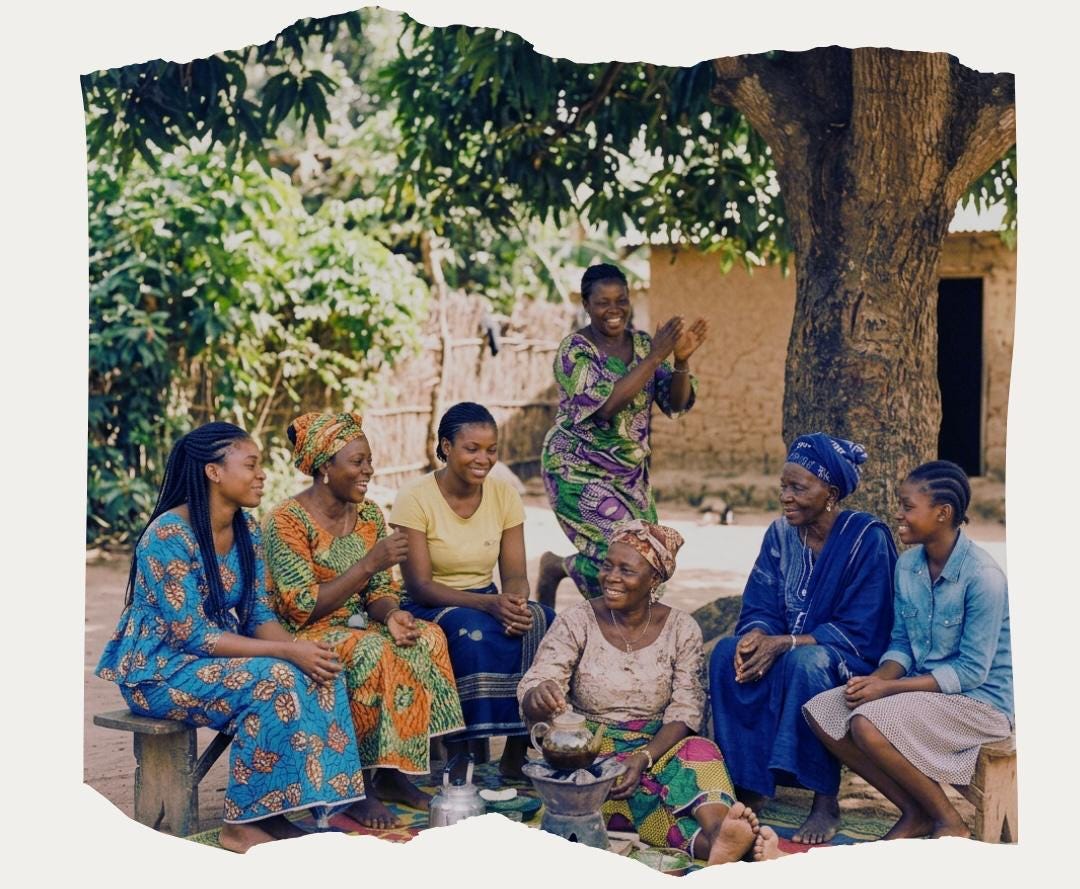
Picture it. A room – maybe a compound, maybe someone’s front porch, maybe a corner of the market – filling up with women. Everyone knows everyone. The greetings alone could take ten minutes. Someone has brought something sweet. The “ataya” is already on the fire, that slow ritual of brewing that cannot be rushed, the first round strong and bitter, the second softer, the third almost like a sigh. The room smells of tea and warmth and the particular comfort of being somewhere you are known.
Then there is her. There is always one – sometimes two if you are lucky – the woman who walks in and immediately the energy shifts. She has not even sat down yet and she is already saying something that makes everyone collapse with laughter. She has a gift, this woman. She can look at the most tired face in the room and find the joke that unlocks it. She carries lightness like it is her contribution to the pot, and in many ways it is. Because what she gives is not small. For one hour, every woman in that room puts down whatever she has been carrying. The worry about the rent. The argument that has not been resolved. The child who has been difficult. The husband who has not noticed. All of it, set down. Just for now. Just for this.
Majai knows exactly what I am talking about. “Even if you come with a lot of stress,” she tells me, her face softening at the memory, “you get relief – because everyone is laughing and cracking jokes, and you forget your worries.” She says it the way someone speaks about something that has carried them through hard seasons. And then she adds: “It is through these “Kafos” and “Osusus” that many women started running businesses.”
And then the business of the Osusu.
Each woman had contributed. Each woman was counted. And each week, one of them went home with the full pot – a sum that no one of them could have gathered alone, made possible because all of them had decided to trust each other.
Fatou understands what that money meant. “The Osusu helps women manage their finances,” she says. “With that bulk money, you can do something meaningful.” And meaningful it was. That money was rarely treated lightly. It was thought about before it arrived. It was planned for. It became the bag of rice that carried the family through a difficult month. The new pot to replace the broken one. The school fees that kept a child in class when everything else was pulling them out. The fabric for a small trading business. The deposit on a market stall. Women built things with their “Osusu” money. Quiet things, modest things, things that do not make the news – but things that held households together and kept children’s futures intact.
Nobody designed this system for them. No institution created it, no government approved it, no development organisation funded it. Women looked at what they had – which was each other – and they built something that worked.
Joy as Resistance, Collectiveness as Solitude
What strikes me most, when I think about these gatherings, is not the practicality of them. It is the joy.
Because these were not easy women living easy lives. They were women managing households on tight budgets, raising children with limited support, navigating marriages and in-laws and community expectations and the daily, grinding labour of keeping everything running. They were tired, many of them, in the deep way that does not go away with one good night of sleep.
And yet.
They dressed up for each other. They laughed until their sides hurt. They brewed tea slowly because some things should not be rushed. They sat together in the kind of comfortable silence that only exists between people who truly know each other, and then they erupted into noise again because one woman said something that set the whole room off.
They found, in each other’s company, something that the outside world was not always offering them: rest. Relief. The feeling of being held.
This is what I mean when I say joy is resistance. Not joy as performance. Not joy as denial of hardship. But joy as a deliberate choice to keep the spirit alive in the middle of difficulty. Joy as the thing that makes it possible to keep going. The “Kafo” women understood this without theorising it. They just kept showing up, in their “ashoebis”, with their laughter, to remind each other that they were more than their burdens.
And there is something else. In a world that can make a woman feel very alone, the “Kafo” offered something irreplaceable: the feeling of belonging. Of mattering. Of being someone’s person and having someone be yours. The collectiveness itself was a kind of solitude – not isolation, but a deep, settled peace that comes from knowing you are not alone. That whatever comes, your circle will come with it.
What We Carry Forward
So when they tell you feminism is foreign, remember the “Kafo”.
Remember the women who showed up without being asked, who cooked and cleaned and fetched water so that one of their own could rest. Remember the “Osusu” circle, the slow “ataya”, the woman who always found the joke that made everyone forget, just for a moment, how heavy life was. Remember the “ashoebis” – the deliberate, joyful, collective choice to be beautiful together.
Remember Fatou, who knows that one woman cannot do things alone. Remember Majai, who knows that relief can live inside a room full of laughter.
These women were not waiting for a word. They did not need one. They had something better: each other.
The “Kafo”. The “Kompin”. The “Osusu”. These were not just cultural traditions. They were blueprints. They were the original architecture of everything we are still trying to build -solidarity, mutual aid, collective joy, the radical insistence that women’s wellbeing matters and that women themselves are the best guardians of it.
We are their inheritors. And every time we show up for one another – in whatever form that takes, in whatever language we use – we are continuing something that was never really interrupted.
It just kept going. In circles. Over tea. In matching fabric. With laughter echoing off the walls.
It has always been here.
Sophiya is a feminist activist based in The Gambia. This is a space for stories about feminism, memory, and the quiet power of Gambian women.